Table of Contents: Testamentary Succession Manual
1. Statutory Foundation: Testamentary Succession under Indian Succession Act, 1925
Under Section 2(h) of the Indian Succession Act, 1925, a Will is defined as "the legal declaration of the intention of a testator with respect to his property which he desires to be carried into effect after his death." Unlike property transfer deeds executed inter vivos (during life) such as Sale Deeds or Gift Deeds, a Will is ambulatory, taking legal effect only upon the biological demise of the testator. During the testator's lifetime, the document confers zero immediate title upon any beneficiary and remains freely revocable at the testator's sole discretion.
Under Section 59 of the Act, every person of sound mind who is not a minor may dispose of their property by Will. Testamentary disposition empowers a citizen to bypass default statutory intestate succession rules, ensuring that lifetime assets—such as real estate, bank accounts, business holdings, and family heirlooms—are distributed strictly according to their personal conscience, protecting financially vulnerable dependents and preventing bitter partition litigation among surviving heirs.
2. Essential Anatomy of a Watertight Will: Clauses that Prevent Litigation
A professionally drafted Will must incorporate specific statutory clauses under Sections 59 to 89 of the Indian Succession Act to survive intense judicial scrutiny:
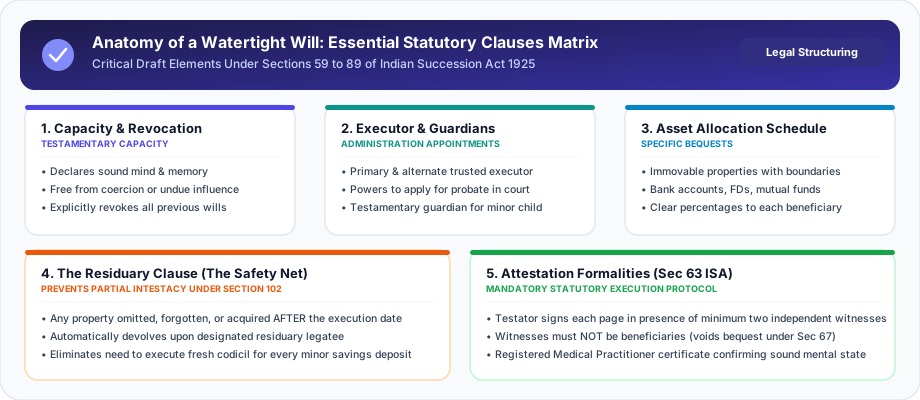
Figure 6.1: Anatomy of a Watertight Will: Statutory Clauses Matrix under Indian Succession Act 1925.
The testator declares that they are of sound disposing mind, free from coercion or undue influence, and explicitly revokes all previous wills, codicils, and testamentary writings executed prior to this date.
Naming a primary trusted executor and an alternate executor to administer the estate, collect debts, settle funeral expenses, and distribute assets. Guardians must also be designated if minor children survive.
Itemized identification of movable assets (bank accounts, FDs, Demat holdings, jewelry) and immovable properties (with municipal numbers, boundaries, and survey coordinates) allocated to named beneficiaries.
The ultimate safety net clause: any property omitted, forgotten, or acquired after the execution date automatically devolves upon the designated residuary legatee, eliminating partial intestacy.
3. Registered Will vs. Unregistered Will: Legal Evidentiary Value
Under Section 18(f) of the Registration Act, 1908, registration of a Will is optional, not compulsory. A Will written on a plain sheet of paper or non-judicial stamp paper is legally valid if properly signed by the testator and attested by two witnesses. However, from an evidentiary perspective, an unregistered Will is highly vulnerable to litigation:
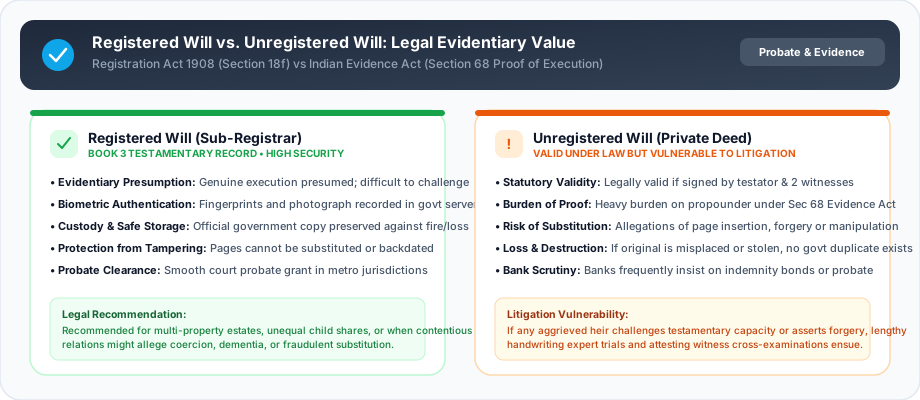
Figure 6.2: Comparative Evidentiary Analysis: Registered Will vs Unregistered Will under Evidence Act.
Evidentiary Advantages of Registering a Will (Book 3):
- Statutory Presumption of Genuineness: Under Section 114 of the Indian Evidence Act, official acts performed by a Sub-Registrar carry a legal presumption of regularity. Challenging a registered Will requires proving serious fraud.
- Biometric & Photographic Proof: The testator's digital fingerprints and webcam photo are permanently embedded in the government database, eliminating false impersonation claims.
- Safe Government Custody: If the original physical Will is misplaced, lost, or destroyed by disgruntled relatives, an official certified copy can be retrieved from Book 3 at the Sub-Registrar's archive.
4. The Two-Witness Attestation Rule & Doctor's Medical Fitness Certificate
Under Section 63(c) of the Indian Succession Act, 1925, a Will must be attested by two or more witnesses, each of whom must have seen the testator sign or affix their mark to the Will, or have received a personal acknowledgment of signature. Both witnesses must sign the Will in the presence of the testator.
Under Section 67 of the Act, if a person to whom or to whose wife or husband any bequest is given in the Will attests the document, that bequest becomes completely void. While the Will itself remains valid for other beneficiaries, the attesting beneficiary forfeits their entire inheritance. Always select independent witnesses who have zero financial interest in the estate.
The Role of the Doctor's Fitness Certificate: To inoculate the Will against future probate challenges alleging that the testator was senile, bedridden, or suffering from Alzheimer's, a Registered Medical Practitioner (MBBS) should examine the testator on the day of execution. The doctor certifies that the testator is oriented in time, place, and person, and possesses sound mental capacity to understand the nature and effect of their dispositions.
5. The Complete Will Lifecycle Flowchart (Drafting to Book 3 Registry)
The flowchart below illustrates the complete 5-stage lifecycle of executing and registering a legally watertight Will:
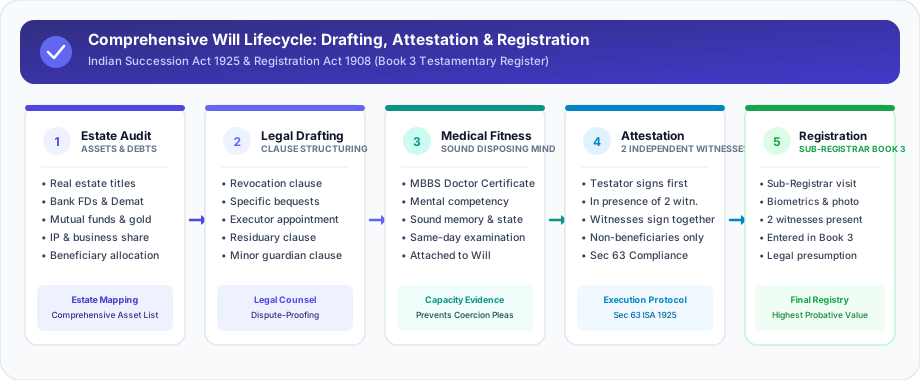
Figure 6.3: Comprehensive 5-Stage Will Lifecycle under Indian Succession Act 1925 & Registration Act 1908.
6. Step-by-Step Procedure for Will Registration at Sub-Registrar Office
Below is the step-by-step protocol for registering a Will before the Sub-Registrar of Assurances:
Finalizing the Will Document & Medical Endorsement
Print the final Will draft on durable ledger paper or legal paper (stamp paper is not mandatory for a Will, but commonly used for the first page). Affix the doctor's fitness certificate and attach property schedules. Testator and two witnesses sign in the designated execution box.
Online Appointment Scheduling & Fee Payment
Book an appointment slot on the state revenue portal (e.g. StockHolding Corporation or state e-Registration portal). Pay the nominal registration fee (ranging from ₹100 to ₹500 depending on state rules) and download the appointment receipt with barcode.
Sub-Registrar Appearance with 2 Witnesses
The testator and both attesting witnesses appear in person before the Sub-Registrar. Carry original Aadhaar cards, PAN cards, passport photos, and two complete copies of the Will.
Biometric Enrollment & Officer Examination
The Sub-Registrar verbally examines the testator to confirm free will and testamentary intent. The biometric fingerprint scanner captures thumb impressions, and a live digital camera captures photographs of the testator and witnesses.
Endorsement & Book 3 Entry Handover
The Sub-Registrar stamps the official registration endorsement seal, assigns a Book 3 Volume and Page number, and returns the registered original Will to the testator. A certified copy is sealed in government archives.
7. Executor Duties, Probate & Letters of Administration
Upon the biological demise of the testator, the Will is brought into legal operation through the appointed Executor. Under Chapter VI (Sections 211 to 337) of the Indian Succession Act, 1925, the executor acts as the legal representative of the deceased for all purposes, vesting the entire estate in their fiduciary care to discharge debts, collect receivables, and distribute net assets strictly in conformity with the testator's bequests.
Under Section 2(f) of the Act, Probate is a copy of a Will certified under the official seal of a competent District Court or High Court, granting administration to the estate of the deceased testator. Under Section 213 read with Section 57, probate is statutorily mandatory ONLY in the historic Presidency towns of Mumbai, Kolkata, and Chennai, or where immovable real estate bequeathed under the Will is situated within these metro municipal boundaries.
Across Delhi, Haryana, Uttar Pradesh, Karnataka, and non-presidency India, obtaining court probate is optional. A registered Will is directly enforceable before statutory authorities, public sector banks, the Delhi Development Authority (DDA), and municipal corporations upon filing indemnity bonds and surviving member certificates, unless an excluded legal heir files a civil dispute challenging the Will's genuineness.
| Succession Instrument | Governing Section | When Applicable | Scope of Assets Covered |
|---|---|---|---|
| Probate | Section 222 (ISA 1925) | Granted ONLY to named Executor when a valid Will exists | All movable & immovable properties listed in Will |
| Letters of Administration (LOA) | Section 234 & 278 (ISA 1925) | Granted to beneficiaries when no executor is named, or in intestate death | All movable & immovable properties in the estate |
| Succession Certificate | Section 370 (ISA 1925) | When deceased died intestate without a Will, primarily for financial dues | Strictly movable assets (bank accounts, shares, provident fund) |
8. Nominee vs. Legal Heir Supremacy & Digital Assets Succession
A ubiquitous legal misconception in India is that naming a nominee on a bank fixed deposit, Demat share portfolio, mutual fund, or housing society flat makes them the absolute owner upon the investor's death. Indian jurisprudence establishes the exact opposite:
Landmark Supreme Court Rulings on Nomination vs. Will:
- Nominee is a Mere Custodian / Trustee: In the landmark decisions of Sarbati Devi v. Usha Devi (1984) 1 SCC 424 and Ram Chander Talwar v. Devinder Kumar Talwar (2010) 10 SCC 671, the Supreme Court ruled that nomination serves only to provide a valid discharge to the financial institution. The nominee holds the funds strictly in trust for the rightful legal heirs or the beneficiaries designated under the deceased's Will.
- Co-operative Housing Society Shares: In Indrani Wahi v. Registrar of Co-operative Societies (2016) 6 SCC 440, the Apex Court reaffirmed that while a housing society must transfer the membership share certificate into the nominee's name, beneficial proprietary title remains governed by testamentary succession or personal succession law.
- Digital Estate & Virtual Assets: Modern estate planning requires express testamentary clauses governing Demat share trading accounts, cryptocurrency private keys, cloud-stored IP, digital creator revenues, and business email domains. Without explicit bequests, digital holdings remain permanently locked under stringent data privacy policies.
9. Codicils, Sealed Cover Deposit & NRI Mirror Wills
Family circumstances and asset portfolios evolve—properties are bought or sold, grandchildren are born, or marital relations alter. The Indian Succession Act and the Registration Act offer structured instruments to manage these changes:
A Codicil is a supplementary legal instrument executed in relation to an existing Will, modifying or adding clauses without revoking the entire structure. It requires identical execution formalities—two independent witnesses and doctor certification.
For substantial changes, legal counsel strongly recommends drafting a completely new Will containing an express revocation clause. Registering the new Will automatically supersedes all prior testamentary drafts, avoiding messy multi-document interpretation before courts.
A testator may deposit their Will in a wax-sealed envelope with the Registrar of Assurances for safekeeping in a fireproof vault. Upon the testator's demise, the Registrar unseals the cover in the presence of legal applicants under Section 45.
Non-Resident Indians (NRIs) with real estate in India and overseas accounts in the USA, UK, UAE, or Canada should execute dual Mirror Wills. Under private international law (lex situs), immovable property is strictly governed by the law where the land is located. A single worldwide foreign will requires expensive consular apostille and ancillary probate under Section 228 of the Indian Succession Act; executing an independent Indian Will for Indian properties ensures rapid, seamless transmission without foreign court intervention.
10. Frequently Asked Questions (FAQs): Will Drafting & Registration
Authoritative legal answers to common succession and estate planning inquiries regarding Wills in India.
Is registration of a Will mandatory in India?
Who can be an attesting witness to a Will?
What is the role of an Executor in a Will?
What is a Residuary Clause and why is it essential?
Why is a Doctor's Medical Certificate recommended when executing a Will?
What is a Codicil?
Where is a Will registered and what is 'Book 3'?
When is Probate of a Will mandatory in India?
Can a person alter or revoke a registered Will during their lifetime?
Can ancestral property be bequeathed through a Will?

Advocate Rahul Singh, B.A. LL.B (Hons.)
Senior Documentation Counsel at SuperEasy Legal Services
Advocate Rahul Singh has over 14 years of specialized legal practice in estate planning, testamentary succession, Will drafting, Sub-Registrar Book 3 registrations, and civil probate litigation. Adv. Singh and his team have successfully facilitated over 15,000 gazette publications and estate planning registrations across India with zero rejection rate.