Table of Contents: Marriage Registry Legal Manual
1. The Supreme Court Landmark Mandate: Why Marriage Registration is Mandatory
In Indian jurisprudence, marriage was traditionally viewed as a sacred religious sacrament solemnized according to personal customs and rituals. However, this lack of statutory documentation left women and children vulnerable during matrimonial disputes, maintenance claims, inheritance succession, and abandonment cases.
To rectify this social and legal vulnerability, the Supreme Court of India delivered its historic judgment in Seema v. Ashwani Kumar [(2006) 2 SCC 578], directing all state governments and Union Territories to enact statutory rules making the registration of marriages compulsory for all citizens, irrespective of religious faith or denomination. A Marriage Registration Certificate issued by a Sub-Divisional Magistrate (SDM), Registrar of Marriages, or Municipal Corporation functions as conclusive statutory proof of the legal marital status of the couple under Section 8 of the Hindu Marriage Act and the Indian Evidence Act.
Vital Legal Functions of a Marriage Certificate:
- Spouse Visa & Immigration: Embassies of the USA, UK, Canada, Australia, and Schengen nations require an official civil Marriage Certificate with Apostille/attestation before issuing dependent, spousal, or permanent residency visas.
- Passport Spouse Endorsement: Streamlined addition of husband or wife's name in Indian Passports and updating maiden surnames.
- Banking, PF & Insurance Claims: Uncontested claim settlements for life insurance policies, EPF provident fund payouts, gratuity, and pension benefits upon the death of a spouse.
- Joint Property Purchase & Home Loans: Availing concessional stamp duty rates for women co-owners and joint banking mortgages.
2. Hindu Marriage Act (HMA) 1955 vs. Special Marriage Act (SMA) 1954
When applying for a Marriage Certificate, couples must determine which parliamentary statute governs their matrimonial union:
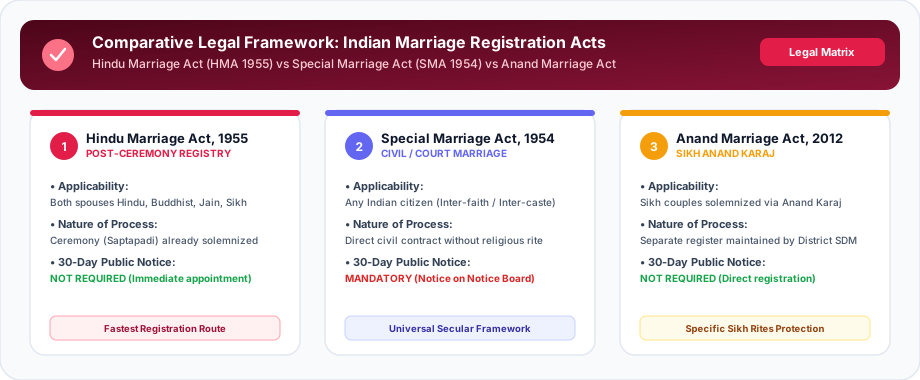
Figure 3.1: Statutory Comparison: Hindu Marriage Act 1955 vs Special Marriage Act 1954.
Applies when both parties are Hindus, Buddhists, Jains, or Sikhs. The marriage must have already been solemnized according to customary religious rituals (such as Saptapadi around the sacred fire). Registration is an administrative act certifying an already existing marriage. No 30-day public notice is required. The certificate can be issued immediately post physical appearance.
A secular civil marriage law enabling any two individuals (irrespective of religion, caste, or nationality) to marry without religious conversion. The marriage is solemnized directly before the Marriage Officer. Mandatory Rule: A 30-day public notice of intended marriage must be published at the SDM office to invite public objections before solemnization.
3. SDM Territorial Jurisdiction & The 5-Stage Verification Workflow
Under Section 8 of HMA and Section 5 of SMA, an application for marriage registration cannot be submitted at random. Territorial jurisdiction is strictly governed by statutory criteria. The application must be filed with the Sub-Divisional Magistrate (SDM) / Marriage Officer within whose territorial boundaries:
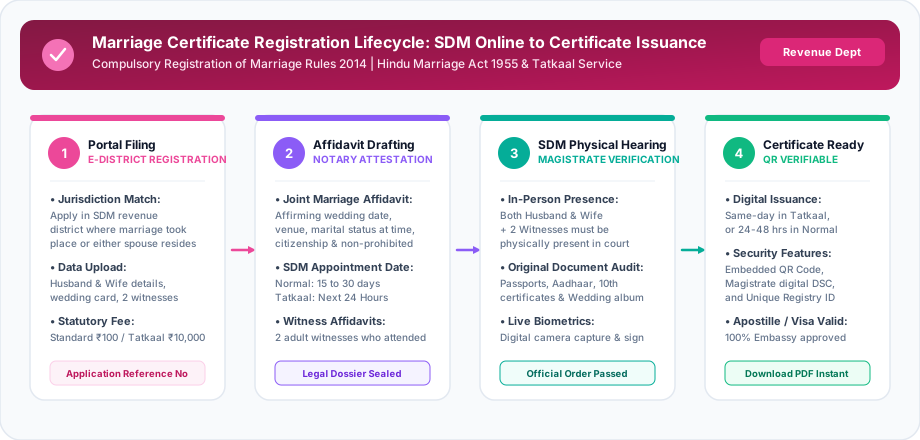
Figure 3.2: The 5-Stage Statutory Workflow: Online Filing to QR-Coded Certificate Issuance.
4. Tatkaal 24-Hour Emergency Marriage Registration Scheme
To accommodate couples facing immediate foreign visa application cutoffs, pending overseas flights, or urgent property transactions, several states (including Delhi, Maharashtra, UP, and Haryana) have notified the Tatkaal Marriage Registration Scheme.
- 24-Hour Appointment Guarantee: The physical appearance before the Sub-Divisional Magistrate is scheduled within 24 working hours of online filing.
- Same-Day Certificate Issuance: Once the SDM completes biometric verification and document scrutiny, the certificate is generated on the same afternoon.
- Statutory Government Fee: The government fee for Tatkaal registration in Delhi is ₹10,000 (compared to ₹100 for normal registration).
- Strict Applicability: Tatkaal registration is available ONLY under the Hindu Marriage Act (where religious ceremony has already occurred). Civil marriages under the Special Marriage Act cannot bypass the mandatory 30-day notice under Section 5.
5. Witness Eligibility Rules & Master Documents Checklist Matrix
A major point of confusion during marriage registration concerns witness qualifications. Under Section 8 of HMA, minimum two (2) witnesses are mandatory; under Special Marriage Act, minimum three (3) witnesses are statutorily required.
- Must be a major of sound mind above the age of 18 years.
- Can be parents, siblings, relatives, friends, colleagues, or neighbors who witnessed the marriage ceremony.
- Must produce original photo identity proof (Aadhaar Card, Voter ID, Indian Passport) and local address proof.
- Must be physically present before the SDM on the date of appointment to sign the Marriage Register and give biometric thumb impressions.
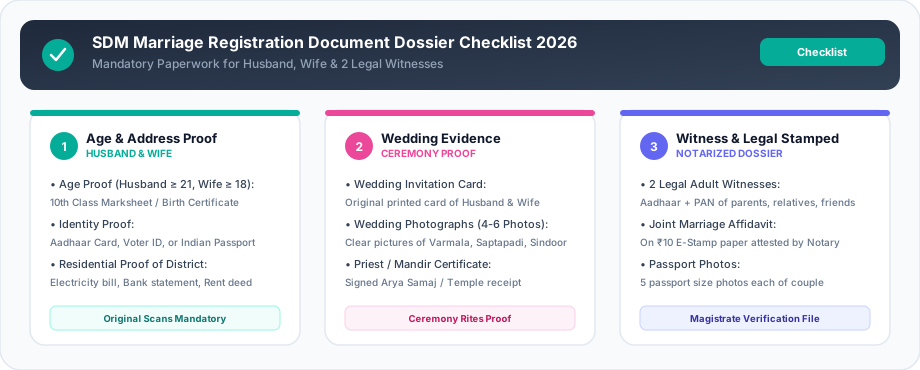
Figure 3.3: Master Document Checklist Matrix: Age, Identity, Marriage Proofs & Affidavits.
| Document Category | Admissible Proofs | Statutory Mandatory Requirements |
|---|---|---|
| Proof of Date of Birth (Age) | 10th Class Board Certificate / Passport / Birth Certificate | Male min. 21 years; Female min. 18 years |
| Proof of Present Address | Aadhaar Card / Voter ID / Registered Rent Agreement | Must establish min. 6-month stay in SDM jurisdiction |
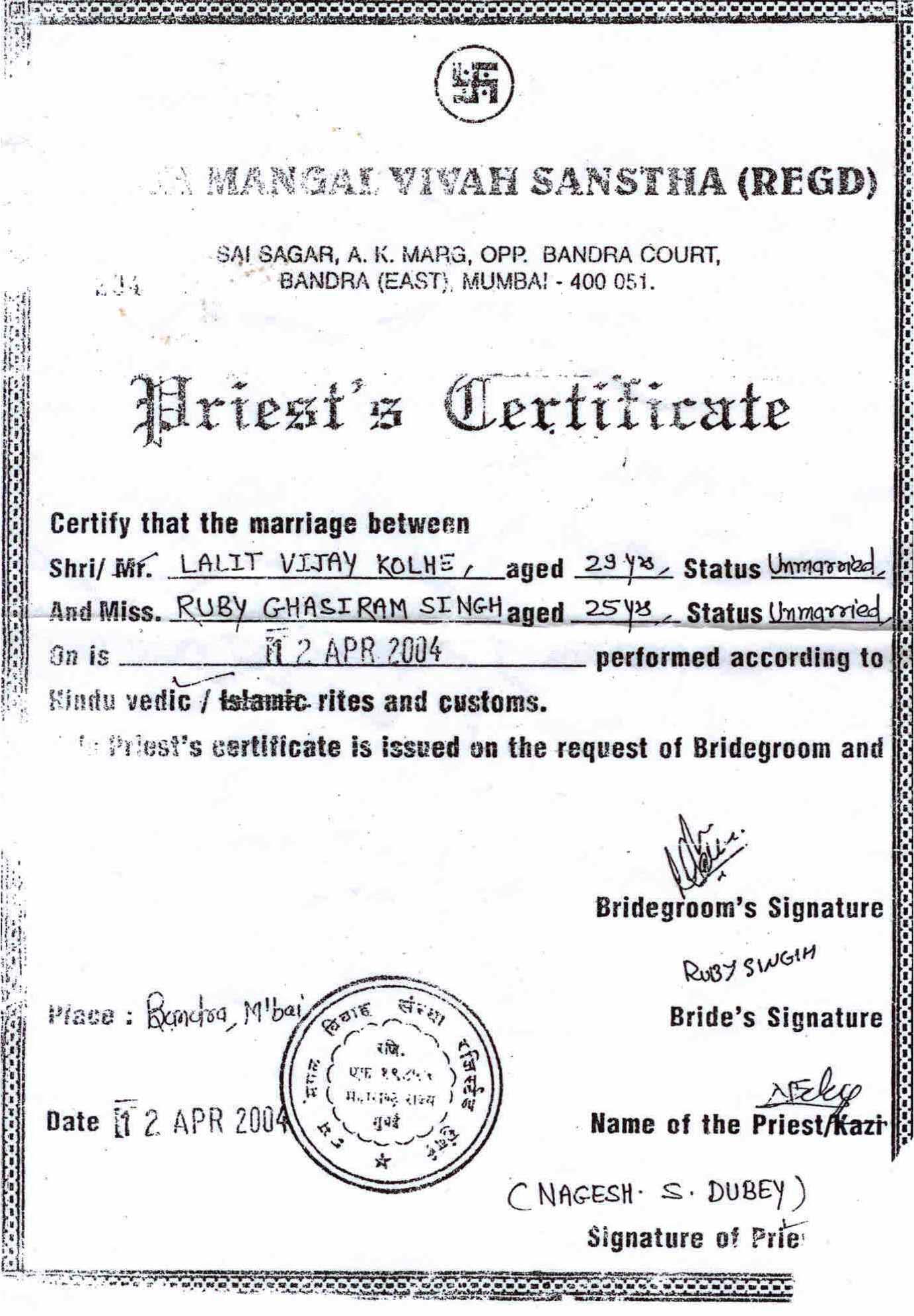
| Proof of Solemnization | Wedding Invitation Card / Priest Certificate / Gurdwara Receipt | Must state date, time, and exact venue address |
| Ceremony Photographs | Joint Postcard (4x6) photograph + Saptapadi / Varmala photos | Clear faces of bride, groom, and solemnizing priest |
| Separate Affidavits | Notarized Stamp Paper Affidavits (one each for husband & wife) | Declaring marital status, Indian citizenship & consent |
6. Step-by-Step Procedure for e-District Marriage Registration
Below is the step-by-step procedure for completing your marriage registration on the state revenue e-District portal:
Portal Registration & Citizen Profile Verification
Create an account on the state e-District portal (e.g., edistrict.delhigovt.nic.in). Complete Aadhaar biometric or OTP e-KYC. Access the Marriage Registration section and select the appropriate Act (Hindu Marriage Act or Special Marriage Act).
Form Entry, Marital History & Witness Particulars
Enter demographic details of husband and wife: maiden names, parents' names, date of birth, religion at time of marriage, address before marriage, and present residential address. Provide the exact date and venue address of solemnization. Enter witness KYC details (names, addresses, relationship to couple).
Document Upload & Notarized Affidavit Submission
Upload self-attested PDF scans of Age Proof, Address Proof, Wedding Invitation Card, Pandit/Priest Certificate, Joint 4x6 photograph, and notarized affidavits executed on non-judicial stamp paper. Ensure file sizes remain within prescribed limits (typically 100 KB to 200 KB per document).
Fee Payment & SDM Slot Scheduling
Pay the prescribed fee online (₹100 for normal registration, or ₹10,000 for Tatkaal fast-track). Select a convenient date and time slot for physical appearance before the Sub-Divisional Magistrate. Download the official Appointment Confirmation Slip containing the barcode.
Physical Appearance & Instant Digital Certificate
Couple and witnesses attend the SDM office with original documents and photocopies. The SDM conducts verbal cross-examination, records biometric finger scans, and captures a live webcam photo. Upon approval, the digitally signed Marriage Certificate with QR Code is generated within 24 to 48 hours for instant download.
7. Foreign National Marriages & Apostille Attestation for Spouse Visas
When one spouse is an Indian citizen and the other is a foreign national, or when an Indian couple requires their Marriage Certificate for foreign permanent residency (PR) or dependent spouse visas (such as US H-4, UK Dependent, Canada Spousal Open Work Permit), additional statutory steps are essential:
Marriages involving a foreign national must proceed under the Special Marriage Act, 1954. The foreign spouse must submit: a valid passport, valid Indian visa, an official No Objection Certificate (NOC) / Certificate of No Impediment issued by their home country embassy in New Delhi, and proof of 30 days continuous stay in the local SDM jurisdiction.
A state-issued Marriage Certificate is not automatically recognized by foreign immigration authorities. Under the Hague Apostille Convention, the certificate must undergo State Home Department Authentication followed by Apostille Legalization by the Ministry of External Affairs (MEA), CPV Division. An Apostille sticker eliminates the need for separate embassy consular legalization across 120+ member nations.
8. Delayed Registration: Condoning Years of Non-Registration
Couples who have been married for five, ten, or twenty years without obtaining a formal government certificate frequently worry that their marriage cannot be registered. Under the law, delayed registration is 100% permissible through a condonation of delay procedure:
- Submit an Affidavit for Condonation of Delay explaining the genuine reasons for non-registration (e.g., lack of awareness, absence of immediate overseas travel, domestic commitments).
- Submit secondary evidence establishing long-term cohabitation: joint bank account statements, birth certificates of children reflecting parents' names, and joint passport copies.
- Pay the compounding late penalty prescribed by the state revenue department (typically ranging between ₹250 and ₹1,500).
- The Sub-Divisional Magistrate records a speaking order condoning the delay and registers the marriage with retroactive effect from the original date of solemnization.
9. Frequently Asked Questions (FAQs): Marriage Registration
Authoritative legal answers to common matrimonial, revenue, and consular questions regarding marriage certificates.
Is marriage registration mandatory in India?
What is the key difference between Hindu Marriage Act (HMA) and Special Marriage Act (SMA)?
How is the territorial jurisdiction of the SDM or Marriage Officer determined?
Who is eligible to be a witness for marriage certificate registration?
What is the Tatkaal Marriage Certificate scheme and how fast is it issued?
What documents are required to register a marriage in India?
Can a marriage between an Indian citizen and a foreign national be registered in India?
What is an Apostille sticker on a Marriage Certificate and why is it needed?
What happens if a marriage was solemnized several years ago and never registered?
Can I download a digitally signed Marriage Certificate online?

Advocate Rahul Singh, B.A. LL.B (Hons.)
Senior Documentation Counsel at SuperEasy Legal Services
Advocate Rahul Singh has over 14 years of specialized legal practice in Central Gazette notifications, civil affidavits, Special Marriage Act procedures, SDM marriage registrations, and statutory identity harmonization. Adv. Singh and his team have successfully facilitated over 15,000 gazette publications and family documentation filings across India with zero rejection rate.