Table of Contents: Legal Heirship Manual
1. Statutory Role & Significance of a Legal Heir Certificate
When an individual passes away intestate (without executing a valid legal Will), their estate—comprising bank balances, fixed deposits, provident fund balances, gratuity, life insurance claims, shares, and immovable properties—does not automatically transfer to their relatives. Under Indian succession jurisprudence, the family must establish who the surviving statutory heirs are according to personal inheritance laws.
A Legal Heir Certificate—statutorily known as a Varisu Certificate in Tamil Nadu, a Warisana Certificate in Northern revenue circles, or a Surviving Member Certificate (SMC) in the National Capital Territory of Delhi—is an administrative document issued under state land revenue codes by the jurisdictional Tehsildar, Talukdar, or Sub-Divisional Magistrate (SDM). It serves as the primary instrument for financial institutions, government departments, and municipal bodies to release dues and recognize the deceased's lawful successors.
Key Administrative Utilities of a Legal Heir Certificate:
- Bank Account & FD Transmission: Enables surviving family members to withdraw savings balances, claim matured fixed deposits, and access bank lockers below court-prescribed limits.
- Service Terminal Benefits: Mandatory for claiming Employee Provident Fund (EPF), gratuity, leave encashment, and family pension from government or private employers.
- Compassionate Appointments: Critical proof for securing employment on compassionate grounds in government and defense services for dependents of deceased employees.
- Utility & Tax Mutation: Transferring electricity meters, water connections, and municipal property tax records to the surviving spouse or children.
2. Class I vs. Class II Legal Heirs Hierarchy (Hindu Succession Act)
When a Hindu, Sikh, Jain, or Buddhist male dies intestate, the devolution of his property is strictly governed by Section 8 of the Hindu Succession Act, 1956. The law establishes an iron-clad hierarchy governed by the Rule of Absolute Exclusion:
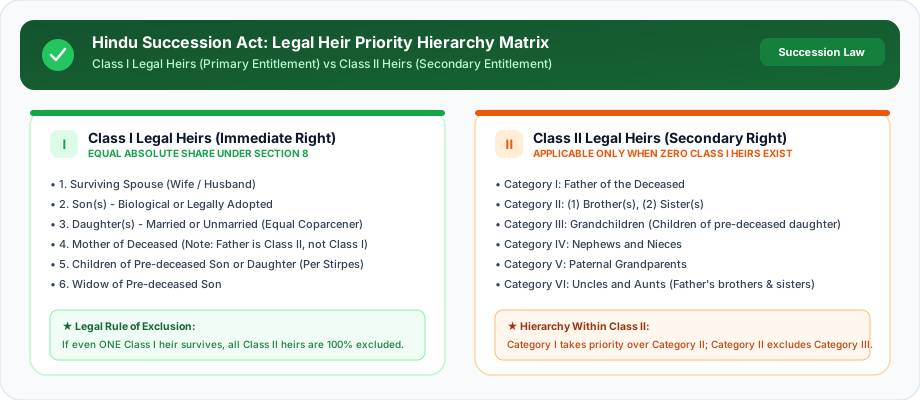
Figure 5.1: Section 8 Statutory Priority Hierarchy: Class I Heirs vs Class II Heirs under Hindu Succession Act.
Class I heirs take the estate simultaneously to the total exclusion of all other relatives. Class I heirs are: 1. Surviving Spouse (Widow), 2. Son(s), 3. Daughter(s) (married or unmarried), 4. Mother of the deceased, 5. Children of pre-deceased sons or daughters (per stirpes), and 6. Widow of a pre-deceased son.
Class II heirs inherit ONLY when the deceased leaves behind ZERO Class I legal heirs. Class II heirs are categorized into sequential entries. Entry I: Father of the deceased. (Crucial legal fact: The Mother is a Class I heir, while the Father is a Class II heir). Entry II: Brothers and Sisters. Entry III: Nephews and Nieces.
In Vineeta Sharma v. Rakesh Sharma [(2020) 9 SCC 1], a 3-judge bench of the Supreme Court held that daughters possess an inherent coparcenary birthright in ancestral property, irrespective of whether they were born before or after the 2005 amendment, and irrespective of whether the father was alive on September 9, 2005. Any Legal Heir Certificate obtained by suppressing a married daughter's existence is fraudulent and criminally prosecutable under the law.
3. Legal Heir Certificate vs. Civil Court Succession Certificate
One of the most frequent points of litigation in Indian estate administration is mistaking a revenue Legal Heir Certificate for a Civil Court Succession Certificate. Understanding their statutory boundaries is critical to avoiding rejected bank claims:
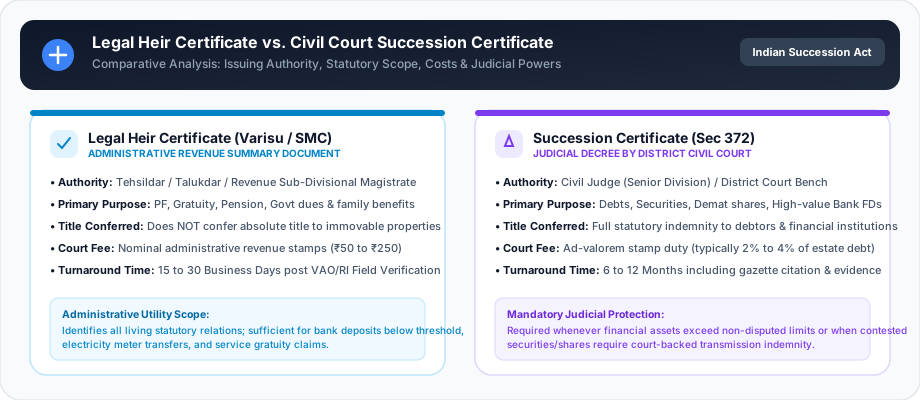
Figure 5.2: Comprehensive Statutory Comparison: Revenue Administrative Certificate vs Judicial Court Decree.
| Comparative Feature | Legal Heir Certificate (Varisu / SMC) | Succession Certificate (Section 372) |
|---|---|---|
| Issuing Authority | Tehsildar / Talukdar / Revenue SDM | Civil Judge (Senior Division) / District Court |
| Statutory Purpose | Family pension, gratuity, PF, basic bank settlements | High-value Demat shares, debts, contested securities |
| Title to Immovable Property | Does NOT confer title to real estate | Limited to debts & securities (Letters of Admin for realty) |
| Government / Court Fee | Nominal revenue stamps (₹50 to ₹250) | Ad-valorem stamp duty (typically 2% to 4% of debt value) |
| Average Turnaround Time | 15 to 30 Business Days | 6 to 12 Months (including newspaper citation) |
4. The 5-Stage Revenue Administrative Workflow (Tehsil to Issuance)
Obtaining a Legal Heir Certificate involves an established administrative sequence under state land revenue codes. The flowchart below maps the statutory journey:
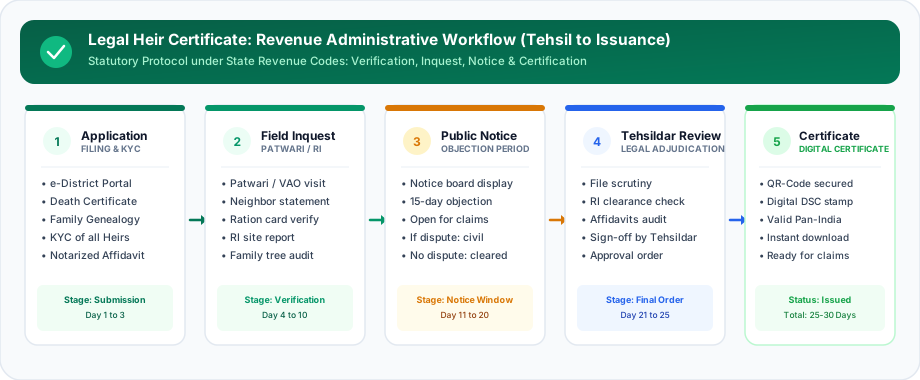
Figure 5.3: The 5-Stage Revenue Workflow: Application, Patwari Inquest, Public Notice, Scrutiny & Certification.
5. Master Documents Checklist for Legal Heir Application
To avoid delay or rejection by the Revenue Inspector, ensure your documentary dossier includes the following self-attested proofs:
- Original/Digitally Verified Death Certificate (MCD/Municipal Corporation).
- Aadhaar Card or PAN Card of the deceased.
- Service retirement book or pension PPO (if applicable).
- Aadhaar Cards and Voter IDs of ALL surviving heirs.
- Birth certificates / 10th mark sheets establishing parentage.
- Marriage certificate of surviving spouse.
- Ration card displaying all family members' names.
- Copy of Parivar Register (for rural jurisdictions).
- Registered electricity or property tax receipt.
- Notarized Family Tree & Heirship Affidavit on stamp paper.
- No-Objection Certificate (NOC) affidavits from co-heirs.
- Indemnity bond indemnifying the Tehsildar against claims.
6. Step-by-Step Procedure for e-District Application
Follow this operational roadmap to file and track your Legal Heir Certificate on state revenue portals:
Portal Registration & Service Selection
Log in to the state revenue portal (e.g. edistrict.delhigovt.nic.in, tnesevai.tn.gov.in, or edistrict.up.gov.in). Navigate to Revenue Services and select "Issuance of Legal Heir Certificate / Surviving Member Certificate".
Deceased Particulars & Family Tree Entry
Enter the deceased person's full name, date of death, Death Certificate registration number, father's/husband's name, and permanent address. Next, add each surviving legal heir sequentially: name, age, relationship to deceased, marital status, and Aadhaar number.
Document Upload & Notarized Affidavit Submission
Upload scanned color copies of the Death Certificate, applicant's identity proof, ration card/parivar register, and the notarized family genealogy affidavit. Submit the application to generate an official Application Reference Number (ARN).
Patwari Ground Inquiry & Tehsil Scrutiny
The jurisdictional Patwari visits the residence or summons the applicant to the Tehsil office along with two local witnesses. The Patwari records witness statements, verifies that all heirs are accounted for, and submits the favorable inquiry report to the Tehsildar.
Digital Certificate Approval & Download
Upon completion of the 15-day notice window, the Tehsildar approves the file and digitally signs the certificate. The applicant downloads the official Legal Heir Certificate equipped with a secure QR code and unique certificate ID.
7. Surviving Member Certificate (SMC) in Delhi NCR: SDM Guidelines
In the National Capital Territory of Delhi, the Revenue Department does not issue a document titled "Legal Heir Certificate"; instead, it issues the Surviving Member Certificate (SMC) under the Delhi Right to Public Services Act:
- Filed exclusively online on the Delhi e-District portal (
edistrict.delhigovt.nic.in). - The Sub-Divisional Magistrate (SDM) conducts physical/video verification of all adult surviving members.
- Each surviving member must execute an individual self-declaration in the prescribed format.
- Statutory delivery timeline is fixed at 21 working days from the date of filing.
- Accepted unconditionally by all banks, DDA (Delhi Development Authority), MCD, and Delhi High Court registry.
8. Handling Disputed Succession & Caveat Petitions
When family relations are contentious—for instance, when a second wife claims rights, an estranged child is excluded, or an illegitimate child asserts paternity—disputes routinely arise during the 15-day public notice period:
The Tehsildar or SDM is a revenue administrative authority, NOT a Civil Court judge. If a caveat petition or written objection is filed questioning paternity, validity of marriage, or alleged adoption, the Tehsildar has no statutory authority to try complicated questions of title or conduct full-fledged evidence trials.
Outcome: The Tehsildar will immediately suspend the revenue application and pass a speaking order directing the claimants to obtain a judicial declaration of heirship or a Succession Certificate from the competent Civil Court under Section 372 of the Indian Succession Act.
9. Frequently Asked Questions (FAQs): Legal Heir Certificate
Authoritative legal answers to common succession, banking, and revenue questions regarding Legal Heir Certificates.
What is a Legal Heir Certificate and who issues it?
What is the key difference between a Legal Heir Certificate and a Succession Certificate?
Who are considered Class I Legal Heirs under the Hindu Succession Act?
Do married daughters have an equal share in the deceased parent's estate?
What is the role of the Patwari or Village Administrative Officer (VAO) in issuing the certificate?
What documents are required to apply for a Legal Heir Certificate?
How long does it take to obtain a Legal Heir Certificate in India?
Can a Legal Heir Certificate transfer ownership of immovable property?
What happens if a legal dispute arises between heirs during the revenue application?
Is a Legal Heir Certificate issued online or offline?

Advocate Rahul Singh, B.A. LL.B (Hons.)
Senior Documentation Counsel at SuperEasy Legal Services
Advocate Rahul Singh has over 14 years of specialized legal practice in estate succession, civil affidavits, Legal Heir Certificate representation, Tehsildar revenue inquests, and statutory identity governance. Adv. Singh and his team have successfully facilitated over 15,000 gazette publications and succession filings across India with zero rejection rate.